Does an AI Earn Your Trust by Answering Well, or by Adapting to You? What 2024–2025 Research Actually Shows
AI 赢得你的信任靠回答好,还是靠适应你?2024–2025 研究真正说明了什么
People do not trust AI because it is smart. 2024–2025 research shows trust is built by calibration, personalization, and repeated interaction — not raw capability. KK Research separates what is proven from KK's own hypothesis, and ties it to the 11-dimension Human Model.
人们信任 AI 不是因为它聪明。2024–2025 研究表明,信任来自校准、个性化与反复互动,而非原始能力。KK 研究将已证内容与 KK 自身假设区分开,并关联到 11 维 Human Model。
KKMatch Human Intelligence Research TeamKKMatch 人类智能研究团队· Research Lead: KK Research· Published: 2026-09-12· Reviewed by: KK Research· 9 min read
Executive Summary
执行摘要
Trust in AI is fragile, situational, and poorly correlated with benchmark capability. Three streams of 2024–2025 evidence converge: (1) public trust surveys show confidence in AI companies is declining and deeply regional; (2) controlled experiments show calibrated uncertainty and personalization raise trust, while over-confidence destroys it; (3) repeated, predictable interaction builds trust across sessions. KK's position: durable human-AI trust is a function of adaptation speed and interaction calibration, not first-turn answer quality. We turn this into a falsifiable hypothesis and a first-party experiment.
对 AI 的信任是脆弱、情境化、且与基准能力弱相关的。2024–2025 的三条证据线汇聚成一致结论:(1) 公众信任调查显示,对 AI 公司的信心在下降且高度区域分化;(2) 受控实验表明,校准的不确定性表达与个性化会提升信任,而过度自信会摧毁信任;(3) 重复、可预测的互动会在多次会话中建立信任。KK 的立场:持久的人机信任是适应速度与互动校准的函数,而非首轮回答质量。我们将其转化为一个可被证伪的假设与一项第一方实验。
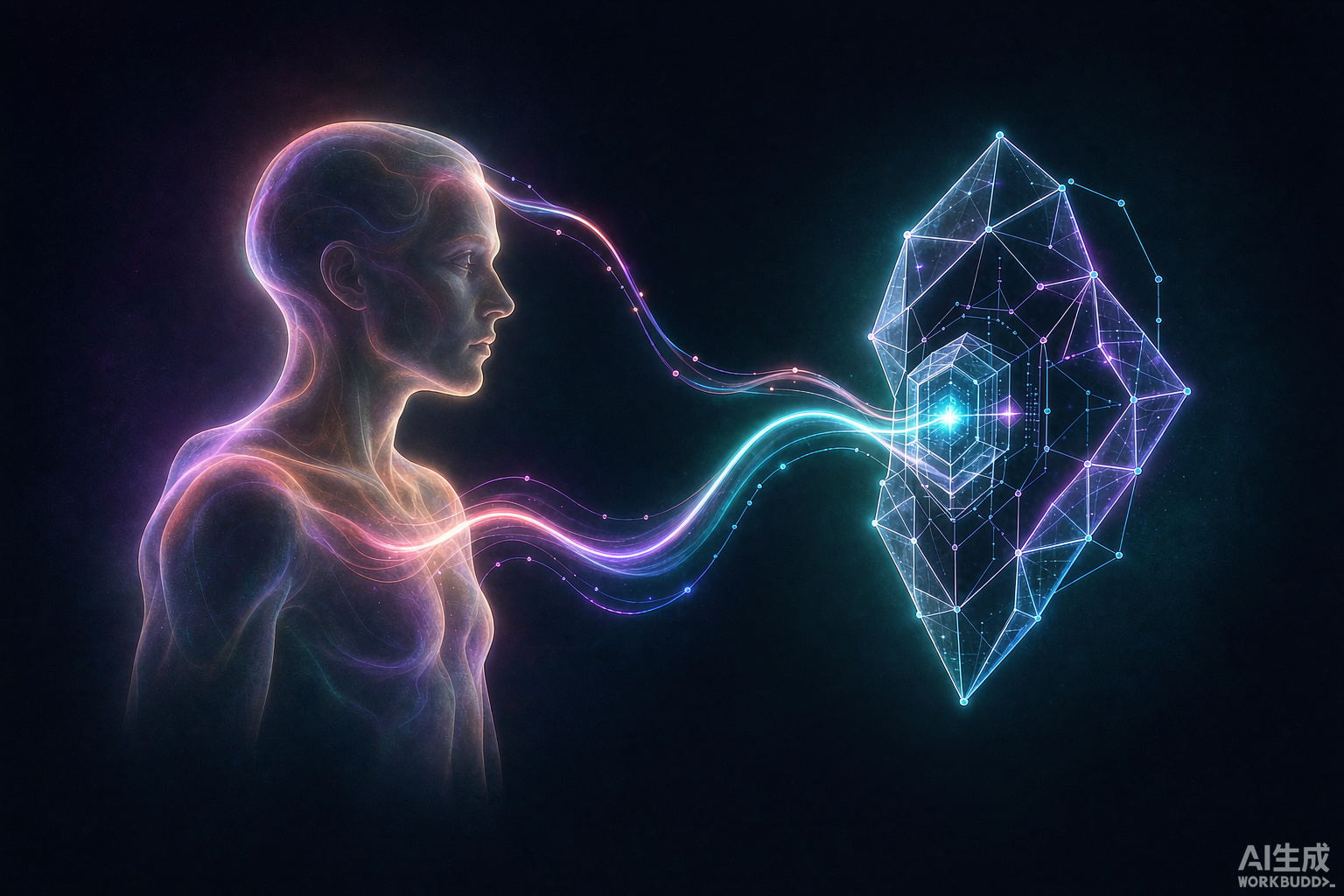
Trust is built by mutual adaptation
信任由相互适应建立
A human and an AI form bend to mirror each other — the visual core of KK's claim that durable human-AI trust is a relationship of adaptation, not a score of capability.人类与 AI 的形体彼此映照弯曲——这正是 KK 主张的可视内核:持久的人机信任是一种适应关系,而非能力的分数。
Generated illustration for KK Research (concept: KH-002 / KH-005).
KK Research 生成的示意插图(概念:KH-002 / KH-005)。
Public trust in AI is regional, not universal
公众对 AI 的信任是区域性的,而非普遍一致
Share of respondents who believe AI does more good than harm, by country (Stanford AI Index 2025). Trust is volatile and region-dependent, not a function of capability.认为 AI 利大于弊的受访者占比,按国家(Stanford AI 指数 2025)。信任是波动且区域分化的,而非能力的函数。
Source: Stanford HAI, AI Index 2025 (grade A).
来源:Stanford HAI,AI 指数 2025(A 级)。
KK Dynamic Model — adaptation speed vs predicted retention (hypothesis)
KK 动态模型 —— 适应速度 vs 预测留存(假设)
An interactive model of KK Hypothesis KH-008: predicted 30-day retention rises the earlier an AI first adapts its strategy to the user. This is a hypothesis, not measured data. Drag the slider.KK 假设 KH-008 的交互模型:AI 越早首次适应用户策略,预测 30 天留存越高。这是假设,而非实测数据。拖动滑块。
Model of KK Hypothesis KH-008 — first-party experiment pending (n≥200).
KK 假设 KH-008 的模型 —— 第一方实验待公布(n≥200)。
KK Interpretation
KK 解读
The research converges on a point KK has long argued: trust is not a score you win by being smart, it is a relationship you build by being calibrated and adaptive. For the 11-dimension Human Model, this means the model must learn each user's interaction preferences — communication style, turn-taking rhythm, topic adaptation — and the system must visibly change its strategy to match. A model that 'knows more' but never adapts is, by the evidence, less trusted than one that adapts well. This is KH-005 in practice: personalization is changing strategy, not hoarding facts.
研究汇聚到一个 KK 长期主张:信任不是靠聪明赢来的分数,而是通过校准与适应建立的关系。对 11 维 Human Model 而言,这意味着模型必须学习每位用户的互动偏好——沟通风格、话轮节奏、话题适应——并且系统要可见地改变策略以匹配。一个“知道更多”却从不适应的模型,按证据来看,比一个适应良好的模型更不被信任。这正是 KH-005 的实践:个性化是改变策略,而非囤积事实。
KK Original Hypothesis KK Original Hypothesis
KK 原创假设 KK Original Hypothesis
KK Hypothesis (KH-002 + KH-005 + KH-006 + KH-008): Human-AI trust formation is driven by adaptation speed — how quickly and visibly an AI changes its interaction strategy to the user — independent of absolute answer quality. We further hypothesize (KH-008) that measured adaptation speed (the turn at which the system first changes strategy to match a user's revealed preferences) predicts sustained trust and retention better than first-session answer quality. These are KK-original, falsifiable claims; they are NOT established science.
KK 假设(KH-002 + KH-005 + KH-006 + KH-008):人机信任的形成由适应速度驱动——AI 多快、多可见地改变其交互策略以适应用户——与绝对回答质量无关。我们进一步假设(KH-008):可测量的适应速度(系统首次改变策略以匹配用户显现偏好的轮次)比首轮回答质量更能预测持续的信任与留存。这些是 KK 原创、可被证伪的主张,并非既定科学结论。
KK Experiment & Data
KK 实验与数据
KK Experiment design (first-party, consented): In Human Mirror sessions, instrument each conversation to record (a) first-session answer-quality proxy (user rating of first 3 answers) and (b) adaptation speed = the turn index at which the system first changes its interaction strategy to match the user's revealed preferences (e.g., switches tone, shortens replies, follows a topic the user introduced). Outcome: 30-day retention and a post-session trust scale. Prediction (KH-008): users whose first strategy-change occurs within the first 3 turns show materially higher 30-day retention than those with equal first-session quality but later adaptation. We will publish results once n ≥ 200 returning, consented users.
KK 实验设计(第一方、已获同意):在 Human Mirror 会话中,对每次对话埋点记录 (a) 首轮回答质量代理(用户对前 3 条回答的评分)与 (b) 适应速度 = 系统首次改变交互策略以匹配用户显现偏好的轮次索引(例如切换语气、缩短回复、跟随用户引入的话题)。结果指标:30 天留存与结束后信任量表。预测(KH-008):首次策略改变发生在前 3 轮内的用户,其 30 天留存显著高于首轮质量相同但适应更晚的用户。回访、已同意用户 n ≥ 200 后我们将公布结果。
Originality & Evidence Policy — Original Research
原创性与证据政策 — 原始研究
Primary and open sources (grade S/A): (1) Stanford HAI AI Index 2025 reports that confidence AI companies protect personal data fell from 50% (2023) to 47% (2024), and only 39% of U.S. and 36% of Netherlands respondents see AI as more beneficial than harmful, versus 83% in China — trust is volatile and regional. (2) Galindez-Acosta & Giraldo-Huertas (2025, arXiv:2511.16769) introduce deferred trust: in an experiment with 55 undergraduates across 30 scenarios, lower prior trust in human agents predicted higher AI selection, and AI dominated factual (not social/moral) scenarios. (3) Jacobsen, Hansen & Argot (2024, Aalborg University) tested 24 participants on chatbot certainty/self-presentation: confident answers raised perceived competence, but over-confidence without substantiation triggered immediate distrust; intentional uncertainty helped calibrate trust. (4) Páez Velazquez (2025, Iscte) found interaction type (task vs reflexive) and predictability shaped trust, with predictability explaining trust variation specifically at second interactions. Limitations across these: small, skewed samples; lab/short-horizon settings; trust measured by self-report, not behavioral retention.
原始研究与开放来源(S/A 级):(1) Stanford HAI《2025 AI 指数报告》显示,认为 AI 公司保护个人数据的信心从 50%(2023)降至 47%(2024),仅 39% 的美国与 36% 的荷兰受访者认为 AI 利大于弊,而中国为 83%——信任是波动且区域分化的。(2) Galindez-Acosta 与 Giraldo-Huertas(2025,arXiv:2511.16769)提出递延信任:在 55 名本科生、30 个情境的实验中,对人类的低先验信任预测了更高的 AI 选择,且 AI 主导事实类(而非社会/道德类)情境。(3) Jacobsen、Hansen 与 Argot(2024,奥尔堡大学)测试了 24 名参与者在聊天机器人确定性与自我呈现上的反应:自信回答提升感知能力,但无依据的过度自信会引发即时不信任;有意的表达不确定有助于校准信任。(4) Páez Velazquez(2025,Iscte)发现互动类型(任务型 vs 反思型)与可预测性塑造信任,且可预测性特别在第二轮互动中解释了信任变化。局限:样本小且偏斜;实验室/短周期设置;信任以自陈而非行为留存衡量。
Strictly, the evidence shows: (a) AI trust is not monotonic in capability — over-confidence and undefended claims reduce it; (b) calibrated uncertainty and personalization increase perceived trust and engagement; (c) trust is built across repeated, predictable interactions, not in a single turn; (d) trust is highly context- and region-dependent. It does NOT show that any specific adaptation mechanism causally produces long-term retention, nor that 'feeling trusted' equals 'kept using it.'
严格地说,证据表明:(a) 对 AI 的信任并非随能力单调递增——过度自信与无依据的断言降低信任;(b) 校准的不确定性表达与个性化提升感知信任与参与度;(c) 信任建立于重复、可预测的互动,而非单次回合;(d) 信任高度依赖情境与地区。它并未证明任何具体的适应机制能因果地产生长期留存,也未证明“感到被信任”等于“持续使用”。
Key Data
关键数据
- Stanford AI Index 2025: data-protection confidence 50%→47% (2023→2024); AI-beneficial share 83% (China) vs 39% (U.S.).
- Deferred trust (2025): n=55, AI chosen in 28.29% of scenarios; factual scenarios favor AI.
- Aalborg (2024): n=24; confident style ↑ perceived competence, over-confidence ↓ trust.
- Iscte (2025): predictability explained trust change at second interactions.
- All trust = self-report; no behavioral retention measured.
- Stanford AI 指数 2025:数据保护信心 50%→47%(2023→2024);认为 AI 利大于弊者占比 中国 83% vs 美国 39%。
- 递延信任(2025):n=55,AI 在 28.29% 情境被选中;事实类情境偏向 AI。
- 奥尔堡(2024):n=24;自信风格↑感知能力,过度自信↓信任。
- Iscte(2025):可预测性在第二轮互动中解释了信任变化。
- 所有信任=自陈;未测行为留存。
Methodology
研究方法
We reviewed one institutional report (Stanford AI Index 2025, grade A) and three 2024–2025 open-access behavioral studies (grade S/A) on human-AI trust. We separated self-reported trust from hypothetical retention, and capability from calibration/personalization. We did not treat any single study as proof of a causal retention mechanism.
我们回顾了一份机构报告(Stanford AI 指数 2025,A 级)与三项 2024–2025 开放获取的行为研究(S/A 级)。将自陈信任与假设性留存、能力与校准/个性化区分开。我们未将任何单一研究视为因果留存机制的证明。
What It Means
这意味着什么
Stop selling AI as 'smartest.' Sell it as 'it learns you.' For KKMatch, the 11-dimension Human Model is the engine that makes adaptation observable and trustworthy, and the metric that matters is retention, not a benchmark leaderboard.
不要再营销 AI “最聪明”,而要营销“它在了解你”。对 KKMatch 而言,11 维 Human Model 是让适应变得可见且可信的引擎,而真正重要的指标是留存,而非基准排行榜。
Limitations
研究局限
Our central claim — that adaptation speed predicts retention over answer quality — is a KK hypothesis (KH-002/005/006/008) without first-party confirmation yet. All cited studies measure self-reported trust over short horizons with small, skewed samples; none measures real behavioral retention. Regional and cultural variation in baseline trust is large and under-explained.
我们的核心主张——适应速度比回答质量更能预测留存——尚为 KK 假设(KH-002/005/006/008),暂无第一方验证。所有被引研究都在短周期内以小而偏斜的样本测量自陈信任,均未测量真实行为留存。基线信任的地区与文化差异很大,且未被充分解释。
What Could Prove KK Wrong What Could Prove KK Wrong
什么可能证明 KK 错误 What Could Prove KK Wrong
If, across n ≥ 200 consented returning users, adaptation speed shows no advantage over first-session answer quality in predicting 30-day retention, KH-008 (and the adaptation-speed pillar of KH-002/006) loses support. If over-confidence consistently outperforms calibrated uncertainty in driving retention, KH-005's 'strategy-change over capability' framing is weakened. If a single static persona matches adaptive personalization on retention, KH-006 is challenged.
Product: instrument adaptation speed as a first-class metric; show users their own interaction baseline so adaptation is visible (calibrated trust). GEO: publish evidence-grade writeups that separate 'AI is smart' hype from 'AI earns trust by adapting' — the defensible, differentiated narrative for KKMatch.
No. 2024–2025 studies show over-confidence without substantiation reduces trust, while calibrated uncertainty and personalization increase it. Capability is not the same as trustworthiness.
What does KK mean by adaptation speed?
The turn at which the AI first changes its interaction strategy to match a user's revealed preferences (tone, length, topic follow). KK predicts earlier adaptation predicts higher long-term retention (hypothesis KH-008).
Why does KK measure retention, not just trust scores?
Cited studies only measure self-reported trust over short sessions. KK's first-party experiment tracks 30-day behavioral retention, which is what durable human-AI relationships actually are.